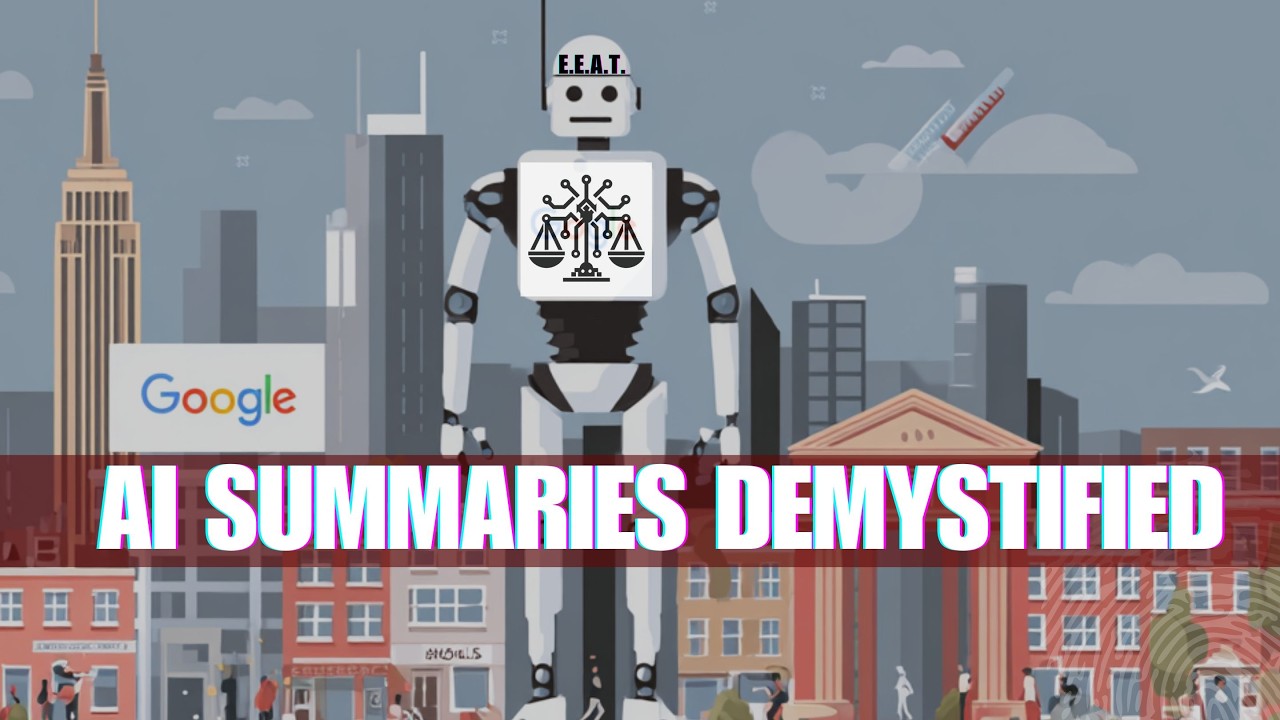
AI SEO and EEAT : How Small Law Firms Can Win in an LLM-First World
3 Min Summary
Clients in New Jersey are no longer “finding a lawyer” by scrolling through blue links—they’re getting near-complete answers from Google’s AI summaries and other large language models (LLMs) before they ever see your homepage.
In a recent episode of the NJ Criminal Podcast, I joined our host, former New Jersey prosecutor and fmr NJ Supreme Court Certified Criminal Trial Attorney Meg McCormick Hoerner, to talk about how this shift creates both risk and unprecedented opportunity for small, merit-driven criminal defense and family law firms.
The firms that will win are not the ones shouting “we do everything” statewide, but the ones whose online footprint proves they are the obvious local authority for specific case types and geographies—
What Google and the ABA increasingly describe through the lens of E‑E‑A‑T
Experience
Expertise
Authoritativeness
Trustworthiness
This article breaks down what we discussed on the show, what the latest guidance (including the ABA-style “adapt your website for LLM traffic” playbook) suggests, and practical next steps for New Jersey firms who feel invisible in an AI-first/zero click/EEAT search world.
Table of Contents
What This Article Covers
Why This Conversation Matters Now in New Jersey
How AI Actually Picks Lawyers Today (Not Just “SEO”)
Understanding E‑E‑A‑T for Law Firms
Why “We Do Everything” Websites Are Hurting You
How LLMs and Google AI Summaries Change “Top of Google”
Practical Steps NJ Firms Can Take for EEAT
Ethics, CLE Requirements, and Safe AI Marketing
How Jornio Maps Real-World Authority for NJ Firms
Frequently Asked Questions (FAQ)
What This Article Covers
I’m writing this as Tom the producer of the NJ Criminal Podcast and our most recent guest + founder of Jornio, a platform focused on helping smaller, highly qualified firms show up as the authority in AI summaries and LLM conversations.
In the episode with Meg, we focused intentionally on the business of law, not the practice of law—how AI decides which lawyers get surfaced, not how lawyers should use AI to draft briefs.
Here, I’ll summarize that conversation, layer in current best practices from emerging “LLM SEO” and ABA-aligned guidance, and EEAT.
Why This Conversation Matters Now in New Jersey
New Jersey attorneys are already being nudged—formally—toward technology competence.
The Supreme Court of New Jersey adopted a requirement that every attorney earn at least one CLE credit in a technology-related subject per two‑year reporting cycle, effective January 2027.
A recent Notice to the Bar proposed amendments to CLE regulations that explicitly call out artificial intelligence as a topic within “technology-related subjects,” with public comment invited from the bar.
On the same timeline, legal marketing and search are undergoing their biggest structural change since Google launched. AI summaries and LLM-style search interfaces answer users’ questions directly, often reducing click-through rates by more than half, while increasing the intent level of the people who do click.
For a small NJ criminal or family firm, that means:
Your next client is likely to meet AI first, not your website navigation.
If AI doesn’t already recognize you as the right entity for that query and that county, you may never enter the conversation.
How AI Actually Picks Lawyers Today (Not Just “SEO”)
On the podcast, Meg asked me the question many lawyers are asking quietly:
“In basic terms, right now, how is AI already picking lawyers for someone who does a Google search for a certain type of lawyer in a certain area?”The short answer: AI is judging entities, not just pages.
Traditional SEO looked heavily at keyword optimization, backlinks, and page-level technical factors. AI summaries and LLMs still care about those, but they zoom out. They look at:
Business registration and history – When was the firm formed? Where? How long has it been in this county?
Locations and footprint – Is this a single-location criminal defense firm in Camden County, or a “50 states” billboard brand? For jurisdictionally sensitive case types, the latter can be a disqualifier.
Public record of expertise – Bar leadership, CLE teaching, appellate arguments, opinions that mention the attorney in the relevant case types.
Niche reputation signals – Testimonials and case results that repeatedly reference the same narrow area, such as DWI, domestic violence, or criminal appeals.
LLMs connect these dots into an entity profile. That profile is far more important to AI than whether your homepage uses “criminal defense lawyer near me” enough times.
What is E‑E‑A‑T?

During the episode, Meg asked about my constant posting on E‑E‑A‑T, and why it matters more now than ever.
The acronym—Experience, Expertise, Authoritativeness, Trustworthiness—encapsulates how AI systems and modern search evaluate whether content (and its author) are credible.
Here’s what that looks like for a New Jersey criminal or family firm:
Experience
What it is: Demonstrable, measurable history in a particular area, such as years in practice, years in a specific county, or depth of work in one case type like DWI or domestic violence.
How AI sees it: Firm formation date, attorney admission dates, long-term presence in local news, and recurring mention in specific types of cases.
Expertise
What it is: Focused practice, certifications, and the scope of what you claim to do.
How AI sees it: If your website menu lists “Criminal, Family, Personal Injury, Wills, Workers’ Comp, Real Estate,” AI will correctly infer that you’re not a deep specialist in any one area.
Authoritativeness
What it is: Recognition by others in your field—leadership roles, CLE teaching, being quoted or cited in decisions or bar publications.
How AI sees it: References in bar association pages, court websites, reputable media, and well-structured bio pages anchored to your name (Person schema, attorney landing pages).
Trustworthiness
What it is: The sense that a reasonable person (or regulator) would trust you with a high-stakes criminal or family matter.
How AI sees it: Longevity in the community, consistent NAP (name, address, phone) data, a coherent review profile, and no obvious “bait-and-switch” marketing (like pretending to handle everything everywhere).
The key shift Meg and I emphasized: E‑E‑A‑T is meritocratic. You don’t buy your way into it with bigger ad spend; you earn it by aligning your digital story with your real-world credentials and results.
Why “We Do Everything” Websites Are Hurting You
Meg shared the very common experience of going into private practice after years as a prosecutor, knowing she “needed a website” and hearing that it should list “everything you might handle.”
In 2013, that advice was common. In 2026, it’s dangerous.
From an AI’s perspective:
A long menu of loosely related practice areas is evidence against deep expertise.
A “statewide” or “50 states” brand can be disqualifying in criminal and family practice, where local jurisdictional savvy and courthouse culture matter more than reach.
A single attorney’s name appearing across too many serious practice areas looks like overclaiming, which undercuts both authority and trust.
One of the simplest, highest-leverage moves Meg and I discussed is this:
“Just stop talking about things you’re not really the authority in.” That might mean:
Removing marginal practice areas from your navigation.
Consolidating scattered practice pages into one or two focused pillars that match your actual case load.
Narrowing location pages to the counties and municipalities where you truly practice and appear regularly.
From an LLM-optimization standpoint, the ABA-2026 Best Practice guidance on EEAT is 100% aligned:
build clear, focused internal entity pages for each attorney, practice area, and office with accurate schema and consistent content.
How LLMs and Google AI Summaries Change “Top of Google”
In the episode, we walked through what has quietly happened to the “top of Google” over the last year:
AI summaries and “AI Mode” style interfaces now occupy 30–50% of the visible space above traditional results.
These summaries stitch together snippets from multiple sites—often three or more citations—from law firm pages, court sites, and authoritative resources.
Many users get 70–90% of the information they need from those summaries and then hop straight into an LLM chat (ChatGPT, Perplexity, Claude) to refine, without ever clicking a traditional result.
That means traditional metrics like “organic sessions” can drop dramatically even as qualified consultations go up—because the people who finally click through from an AI answer have already pre-qualified themselves.
From a practical standpoint, the modern guidance (including the “9 ways to adapt your site for LLM traffic” style articles) comes down to a few structural content rules:
Lead with direct answers – First 50–150 words should answer the question plainly.
Use question-based headings – H2s and H3s that mirror real client queries (“What happens if I’m arrested in New Jersey with an out-of-state gun?”).
Break complex topics into clusters – Instead of one generic “Domestic Violence” page, create a cluster: initial arrest, first appearance, restraining order implications, collateral consequences, etc.
Add FAQ sections and key takeaways – LLMs love structured Q&A and summary blocks at the end of long articles.
When you combine that structure with genuine E‑E‑A‑T signals, you give AI a reason to quote your site instead of a generic “legal information” portal.
Practical Steps NJ Firms Can Take This Month
Here’s how to turn all of this into action that doesn’t require you to become a full-time webmaster.
1. Audit Your Story for Consistency
Take a one-hour pass at your:
Website practice area menu
Attorney bios
Google Business profile
LinkedIn and other social profiles
Ask: “Does this story match what we actually do best, in the places we actually practice?”
If the answer is “not quite,” make small but real edits:
Remove practice areas that were “nice to have” but haven’t driven real cases in years.
Clarify primary counties and courts served for criminal and family.
Tighten bios so each attorney is clearly associated with specific case types.
2. Restructure One Core Practice Page for LLMs
Pick your most important page (for example, “New Jersey Domestic Violence Defense”) and:
Add a 2–3 sentence extractable summary at the top that answers the core question.
Rewrite H2s as real questions clients ask: “What happens after a domestic violence arrest in New Jersey?”
Add a 5–7 question FAQ at the bottom that mirrors intake conversations.
You’ve now created a page that is more quotable for AI without changing your legal analysis.
3. Stop Wearing (and Advertising) Too Many Hats
If you’re primarily a criminal defense firm but your site says “Criminal – PI – Employment – Immigration – Wills,” decide what you’re actually willing to stake your reputation on.
Remove or de-emphasize areas where you’re not willing to be the attorney AI calls on for a high-stakes answer.
4. Strengthen Entity and Schema Signals (With Help if Needed)
Have your developer or marketing partner:
Implement Organization, LocalBusiness, and Person schema with accurate addresses, counties, bar numbers, and practice focus.
Ensure each location has unique, consistent data (no “12 pretend offices” scattered statewide).
Create or tighten dedicated pages for each attorney and key practice area.
This is exactly the sort of technical foundation “adapt your site for LLM traffic” guides emphasize as table stakes.
Ethics, CLE Requirements, and Safe AI Marketing
Meg spends a lot of time teaching ethics CLEs in New Jersey, and we were intentional about drawing a bright line:
AI in the practice of law (drafting, research, confidential information) is governed by evolving ethics opinions and will be squarely covered by the new tech CLE requirement.
AI in the business of law (how you are discovered and represented online) is about aligning your marketing with the truth of your experience and avoiding misleading claims.
Done right, E‑E‑A‑T-focused AI optimization actually reduces risk:
You stop advertising practice areas you don’t truly handle.
You document and highlight credentials that bar regulators would recognize as legitimate indicators of competence.
You structure content as education, with clear disclaimers that it is not individualized legal advice.
The ethics problems we’re seeing nationally—fabricated cases, AI-written briefs with no verification—are not inherent to AI itself; they’re about how lawyers choose to use it. Properly framed, AI-assisted visibility is fully aligned with New Jersey’s consumer-protection goals in attorney advertising.
How Jornio Maps Real-World Authority for NJ Firms
On the episode, I described Jornio’s role as less “SEO vendor” and more “translator” between real-world authority and what AI can recognize.
For NJ criminal and family firms, that typically looks like:
Authority Mapping
We inventory your actual experience: case types, courts, years in each county, bar leadership, CLEs, community involvement, and consistent testimonial patterns.
We compare that against competitors in your exact geography and practice lanes to see where you have an undeniable advantage.
Content Clusters & Structure
We design long-form, AI-friendly guides around the stages of a specific case type (for example, “out-of-state gun charges in New Jersey” or “post-conviction relief”).
We structure headings, summaries, FAQs, and internal links so that LLMs can excerpt and cite you easily, while you still sign off on every word.
Multi-Platform Amplification
For each guide, we create snippets and social posts (often via your marketing person or internal team) so that Google and AI see consistent signals about who you are and what you do.
Ethics-First Review
Every piece is reviewed by the attorney; we never publish on a lawyer’s behalf.
Claims are tied to verifiable facts—certifications, years in practice, courts where you appear—rather than “rah rah” superlatives.
We’ve seen scenarios where a Spanish-speaking PI-only attorney with 30 years serving one community is able to dominate AI visibility in one of the most competitive counties in the country, on a fraction of the ad budget her large competitors spend, simply because the structure finally lets AI see what’s been true for decades.
Frequently Asked Questions (FAQ)
Q: Does AI care how much traffic my website gets?
No. Traffic is a noisy signal; it can be driven by ads, generic content, or even personality-driven social media. AI and LLMs focus on quality and relevance, not raw visit counts.
Q: If I narrow my practice areas online, will I lose business?
In our experience, narrowing your visible focus tends to increase qualified inquiries and decrease time wasted on cases you would decline anyway. AI and clients both favor the firm that clearly “owns” one or two lanes over the one that claims ten.
Q: Is this just another version of SEO with different buzzwords?
No. Traditional SEO could often be gamed with backlinks and keyword tricks. LLM optimization and E‑E‑A‑T require your real-world resume to match your marketing. You can’t fake bar leadership, decades in one county, or a review profile full of one case type.
Q: How does this interact with New Jersey’s ethics rules on advertising and testimonials?
Properly executed, this approach supports compliance: you emphasize verifiable experience instead of “I’m the best,” you avoid implying expertise you don’t have, and you use testimonials carefully in light of recent ethics guidance and case law. Meg covers those nuances in her CLEs; nothing here replaces formal ethics advice, but it is designed to align with it.
Q: Where should I start if I only have a few hours this month?
Start by removing practice areas you no longer want to be known for, rewriting one key practice page around direct answers and FAQs, and making sure your Google Business profile precisely matches your primary office and practice description. Those three steps alone can make you look much more like the focused authority AI is trying to surface.
If you’d like to hear the full conversation with Meg—and hear this broken down in plain language for New Jersey practitioners—listen to the episode and then explore how your own digital footprint lines up with the authority you’ve already earned in the courtroom.
Or, jump to a specific chapter of interest on Youtube:
00:00 Intro & why AI in the business of law matters
00:09 NJ tech CLE requirement & AI in CLE proposals
06:03 How Google’s AI summaries changed “the top of the page”
10:31 Entity vs. SEO: how AI actually picks lawyers
21:21 What EEAT really means for law firms
29:25 Why pretending to “do it all” kills your authority
36:42– What Jornio’s EEAT authority audits and content clusters look like
46:42 One small step lawyers can take this week
51:19 Free EEAT AI SEO authority map & content cluster offer for NJ firms

Jeffrey Epstein - I Told You So